
Weekly Brief
Be first to read the latest tech news, Industry Leader's Insights, and CIO interviews of medium and large enterprises exclusively from The Manufacturing Outlook
A featured contribution from Leadership Perspectives: a curated forum reserved for leaders nominated by our subscribers and vetted by our Manufacturing Outlook Europe Advisory Board.


Evgenia Leivadarou, George Chryssolouris
Europe cannot afford to have factories exclusively for defense, while sustaining separate industrial systems for civil and defense production. This is a structural constraint and an economic condition to be considered for defense investments.
Global manufacturing has shifted. China produces about $4.66 trillion in manufacturing value added, around 29% of global output. The United States produces around $2.5 trillion, but manufacturing accounts only 10.7% of its GDP. Similarly, the European Union produces about $2.33 trillion, around 15% of GDP. However, compared to the other continents, Europe sits between scale and specialization, without dominating in either.
At the same time, Europe is dependent on external inputs. Only 8.6% of raw materials globally come from recycling. In the EU, critical materials often have recycling rates below 1%, which leads to exposure to supply crises and limits industrial autonomy.
Demographics reinforce the constraint. Europe’s population will remain almost stable until 2050. As a result, EU’s share of the global economy is projected to decline from about 14.7% to 9%, labor supply will be constrained and industrial capacity will not expand easily.
At the same time, defense demand is rising and provides an opportunity for a structural shift towards industrial spending. EU defense expenditure reached about €343 billion in 2024, an increase by 19% compared to 2023. Investment in equipment and R&D exceeded €100 billion, and procurement alone reached €88 billion.
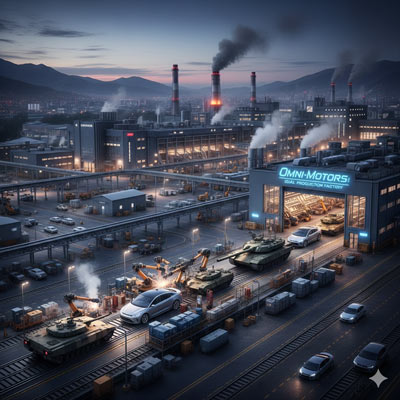 This high level of investment creates a contradiction for business and sustainability. Defense requires capacity, but defense demand is not constant. It increases during crises and decreases in periods of stability. Factories dedicated solely to defense remain underutilized in peacetime, reducing return on capital and weakening industrial sustainability. Other regions can absorb this inefficiency. For instance, the US operates large-scale defense systems with sustained demand. China integrates civil and military production within a state-driven industrial model. However, Europe operates a fragmented, multi-state industrial system, with limited budgets and strict regulation. It cannot replicate either model.
As a result, Europe cannot afford defense-only factories in the long term and will have to explore the alternative of using the existing industrial capacity. This is already happening, with automotive factories, producing defense components and electronics companies, producing secure communication or airborne systems. However, these are partial solutions and a more structural approach could ensure the sustainability of manufacturing systems across the EU.
Dual-use technologies already exist, with many technologies serving both civil and defense markets. However, production systems remain separated, creating delays, increasing costs and limiting scale.
The next step is the transition from dual-use technologies to dual-use factories: they are structured as manufacturing systems that can switch between civil and defense production, operating in civilian markets under normal conditions and changing their capacity during crises.
This approach entails a manufacturing configuration with modular production lines. Working cells and equipment are designed to be rearranged, while processes can be adapted, allowing the switching of production lines without a complete redesign. Industry 4.0 technologies are essential for the proposed manufacturing model. Digital twins simulate changes in production, with AI supporting planning and rescheduling. Data infrastructures connect systems and coordinate processes, reducing switching time and uncertainty.
As shifting must be feasible, fast and economically justified, the objective can be measurable. Three conditions define feasibility. First, reconfiguration and disruption costs must be lower than maintaining separate capacity, while idle defense capacity should be minimized. Second, the transition time from civil to defense production must be short and the ramp-up must be predictable. Third, flexible systems have to support multiple products and volumes without loss of performance. These are measurable attributes of manufacturing systems, already well documented in scientific literature and applied in manufacturing sites.
Dual-use factories aim to minimize disruption costs and downtime when switching production. Recent and urgent disruptions have confirmed the need for dual-use factories. During the COVID-19 pandemic, factories shifted to medical production. The shift has been slow, requiring redesign and new certifications. Manufacturing in the EU can achieve the flexibility for faster and more structured adaptations. Future disruptions may be more frequent, triggered by geopolitical shocks, supply-chain shortages and rapid changes in demand.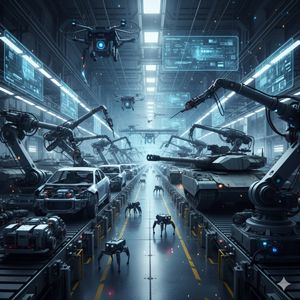
Dual-use factories provide a response mechanism and address resource constraints, both of which are critical for Europe’s dependencies. Joint production reduces duplication, while circular manufacturing and remanufacturing can increase material efficiency. Dual-use factories also address labor constraints, as a single workforce supports both markets, skills are retained and training is centralized.
Barriers exist, but they define a clear path for implementation and coordination. Differences in certification between civil and defense sectors can be aligned to enable integrated production. Procurement systems can evolve to match the speed of civilian innovation, reducing long development cycles. Security constraints, including export controls and classification rules, can be structured to allow controlled collaboration and targeted knowledge sharing. Organizational gaps can be addressed by establishing dedicated dual-use assessment functions and developing reconfiguration skills within industry. These are institutional challenges, while the technical basis already exists.
The direction for dual-use capabilities has already been defined in EU policy. The next step is effective and scientifically sound implementation to establish a sustainable manufacturing model across the EU. Europe does not lack technology, but it lacks scalable, adaptable production systems.
The core argument is simple. Dual-use factories provide a business model, where one system serves two markets, securing continuous operations. This is a unique opportunity to satisfy defense demand while securing industrial resilience. The solution is not more factories. It is better factories.
The articles from these contributors are based on their personal expertise and viewpoints, and do not necessarily reflect the opinions of their employers or affiliated organizations.
